
 A pair of dwarf galaxies, NGC 4490 and NGC 4485, have often been imaged before, but JWST has revealed a bridge of stars and gas connecting them, showcasing exactly how and where new stars are forming in these interacting galaxies, as well as allowing us to trace the timescale of this merger, which began 200 million years ago and then experienced a newer, more intense interaction just 30 million years ago.
Credit: ESA/Webb, NASA & CSA, A. Adamo (Stockholm University), G. Bortolini, and the FEAST JWST team
Key Takeaways
A pair of dwarf galaxies, NGC 4490 and NGC 4485, have often been imaged before, but JWST has revealed a bridge of stars and gas connecting them, showcasing exactly how and where new stars are forming in these interacting galaxies, as well as allowing us to trace the timescale of this merger, which began 200 million years ago and then experienced a newer, more intense interaction just 30 million years ago.
Credit: ESA/Webb, NASA & CSA, A. Adamo (Stockholm University), G. Bortolini, and the FEAST JWST team
Key Takeaways
- Each time we improve our views of the Universe, with better resolution, better wavelength coverage, and more light gathered overall, we start to reveal features that we simply couldn’t see previously.
- JWST is the largest, most sensitive space telescope ever launched, with imaging capabilities in the near-infrared and mid-infrared that surpass all other ways of viewing many aspects of the Universe in history.
- While the early images of JWST, which began science operations back in 2022, were spread far and wide, the observatory continues to deliver in ways that astound, delight, and inform. Catch what you may have missed!
 Sign up for the Starts With a Bang newsletter
Travel the universe with Dr. Ethan Siegel as he answers the biggest questions of all.
Subscribe
Sign up for the Starts With a Bang newsletter
Travel the universe with Dr. Ethan Siegel as he answers the biggest questions of all.
Subscribe
From 2022 onward, JWST began revolutionizing our cosmic perspective.
 This side-by-side view shows the same object, the Pillars of Creation, as captured by JWST in both mid-infrared light (at left) and in near-infrared light (at right). Note the different features revealed as far as stars, dust, gas, and other features within the nebula. Different wavelengths are sensitive to different types of features, including for features beyond the limits of JWST.
Credit: NASA, ESA, CSA, STScI; J. DePasquale, A. Koekemoer, A. Pagan (STScI)
This side-by-side view shows the same object, the Pillars of Creation, as captured by JWST in both mid-infrared light (at left) and in near-infrared light (at right). Note the different features revealed as far as stars, dust, gas, and other features within the nebula. Different wavelengths are sensitive to different types of features, including for features beyond the limits of JWST.
Credit: NASA, ESA, CSA, STScI; J. DePasquale, A. Koekemoer, A. Pagan (STScI)
Its spectacular early results broke records and inspired awe.
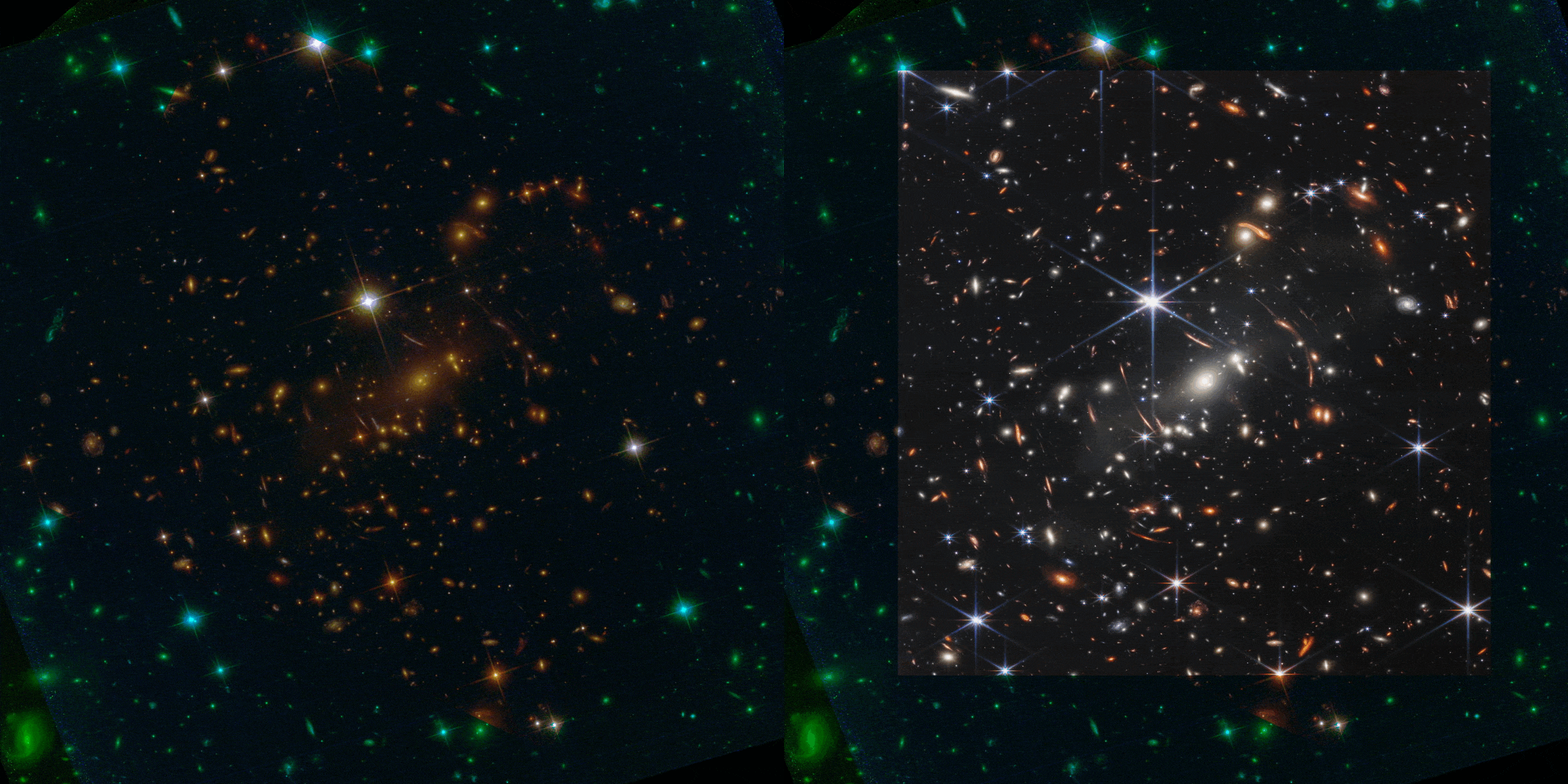 This almost-perfectly-aligned image composite shows the first JWST deep field’s view of the core of cluster SMACS 0723 and contrasts it with the older Hubble view. The JWST image of galaxy cluster SMACS 0723 is the first full-color, multiwavelength science image taken by the JWST. It was, for a time, the deepest image ever taken of the ultra-distant Universe, with 87 ultra-distant galaxy candidates identified within it. Most are still awaiting spectroscopic follow-up and confirmation to determine how distant they truly are.
Credit: NASA, ESA, CSA, and STScI; NASA/ESA/Hubble (STScI); composite by E. Siegel
This almost-perfectly-aligned image composite shows the first JWST deep field’s view of the core of cluster SMACS 0723 and contrasts it with the older Hubble view. The JWST image of galaxy cluster SMACS 0723 is the first full-color, multiwavelength science image taken by the JWST. It was, for a time, the deepest image ever taken of the ultra-distant Universe, with 87 ultra-distant galaxy candidates identified within it. Most are still awaiting spectroscopic follow-up and confirmation to determine how distant they truly are.
Credit: NASA, ESA, CSA, and STScI; NASA/ESA/Hubble (STScI); composite by E. Siegel
However, these 10 recent JWST images surpassed even our imaginations.
 The quadruply gravitationally-lensed quasar RX J1131-1231 is located roughly 6 billion light-years away, with a single foreground galaxy serving as the gravitational lens. Combined with X-ray emissions, we learn that the central black hole spins at approximately half the speed of light.
Credit: ESA/Webb, NASA & CSA, A. Nierenberg
The quadruply gravitationally-lensed quasar RX J1131-1231 is located roughly 6 billion light-years away, with a single foreground galaxy serving as the gravitational lens. Combined with X-ray emissions, we learn that the central black hole spins at approximately half the speed of light.
Credit: ESA/Webb, NASA & CSA, A. Nierenberg
10.) The best quadruply-lensed quasar.
 This zoomed-in view of the quadruply-lensed quasar RX J1131-1231 showcases variations in brightness and magnification of the background object enhanced by the gravitational lens. The clustering of three of the images, with a fainter image on the opposite side, showcases the imperfect alignment between the observer, the lens, and the background source.
Credit: ESA/Webb, NASA & CSA, A. Nierenberg
This zoomed-in view of the quadruply-lensed quasar RX J1131-1231 showcases variations in brightness and magnification of the background object enhanced by the gravitational lens. The clustering of three of the images, with a fainter image on the opposite side, showcases the imperfect alignment between the observer, the lens, and the background source.
Credit: ESA/Webb, NASA & CSA, A. Nierenberg
Four independent images join an Einstein ring.
 This extremely young star cluster began forming stars only within the last 3 million years, making it one of the youngest star clusters known in existence. The orange color, to JWST’s eyes, represents gas that glows with heat in the infrared, powered by outflows from young, massive Herbig-Haro objects.
Credit: ESA/Webb, NASA & CSA, A. Scholz, K. Muzic, A. Langeveld, R. Jayawardhana
This extremely young star cluster began forming stars only within the last 3 million years, making it one of the youngest star clusters known in existence. The orange color, to JWST’s eyes, represents gas that glows with heat in the infrared, powered by outflows from young, massive Herbig-Haro objects.
Credit: ESA/Webb, NASA & CSA, A. Scholz, K. Muzic, A. Langeveld, R. Jayawardhana
9.) Herbig-Haro stars in star-forming NGC 1333.
 This nebula in the Perseus molecular cloud, NGC 1333, is located only 960 light-years away here in our own Milky Way. While Hubble can only capture the light-blocking dust and heated gaseous material, JWST is spectacular at viewing an enormous number of obscured stars and cooler material that is invisible to Hubble.
Credit: NASA, ESA, STScI
This nebula in the Perseus molecular cloud, NGC 1333, is located only 960 light-years away here in our own Milky Way. While Hubble can only capture the light-blocking dust and heated gaseous material, JWST is spectacular at viewing an enormous number of obscured stars and cooler material that is invisible to Hubble.
Credit: NASA, ESA, STScI
JWST sees newborn stars, brown dwarfs, and planets, surpassing Hubble’s hazy views.
 The open star cluster Westerlund 1 was only discovered in 1961, and is one of the only super star clusters known within the Milky Way. Located 12,000 light-years away, it has the greatest density of massive, young stars found anywhere within the Milky Way itself.
Credit: ESA/Webb, NASA & CSA, M. Zamani (ESA/Webb), M. G. Guarcello (INAF-OAPA) and the EWOCS team
The open star cluster Westerlund 1 was only discovered in 1961, and is one of the only super star clusters known within the Milky Way. Located 12,000 light-years away, it has the greatest density of massive, young stars found anywhere within the Milky Way itself.
Credit: ESA/Webb, NASA & CSA, M. Zamani (ESA/Webb), M. G. Guarcello (INAF-OAPA) and the EWOCS team
8.) Newborn stars in Westerlund 1.
 This close-up of the stars in Westerlund 1 showcases JWST’s resolution and sensitivity to cool, obscured stars. The wispy red material represents dusty material surrounding the star cluster that hasn’t been fully boiled or evaporated away, while the cluster itself contains between 50,000 and 100,000 solar masses worth of material.
Credit: ESA/Webb, NASA & CSA, M. Zamani (ESA/Webb), M. G. Guarcello (INAF-OAPA) and the EWOCS team
This close-up of the stars in Westerlund 1 showcases JWST’s resolution and sensitivity to cool, obscured stars. The wispy red material represents dusty material surrounding the star cluster that hasn’t been fully boiled or evaporated away, while the cluster itself contains between 50,000 and 100,000 solar masses worth of material.
Credit: ESA/Webb, NASA & CSA, M. Zamani (ESA/Webb), M. G. Guarcello (INAF-OAPA) and the EWOCS team
A foreground interstellar cloud can’t hide this super star cluster.
 The spiral galaxy NGC 2566, located approximately 76 million light-years away, is one of 55 relatively nearby galaxies studied as part of a JWST program to understand the relationship between stars, gas, and dust in galaxies that are actively forming new stars. Many wispy structures are seen in red, highlighting the presence of dust, while blue colors highlight the presence of stars. In green and yellow, background galaxies galore can also be spotted.
Credit: ESA/Webb, NASA & CSA, A. Leroy
The spiral galaxy NGC 2566, located approximately 76 million light-years away, is one of 55 relatively nearby galaxies studied as part of a JWST program to understand the relationship between stars, gas, and dust in galaxies that are actively forming new stars. Many wispy structures are seen in red, highlighting the presence of dust, while blue colors highlight the presence of stars. In green and yellow, background galaxies galore can also be spotted.
Credit: ESA/Webb, NASA & CSA, A. Leroy
7.) Spiral galaxy NGC 2566’s gas-rich structures.
 This spectacular Hubble view of galaxy NGC 2566 may be more familiar than the JWST view of the same object, showcasing a central bar and dust lane, followed by a circular concentration of newborn stars glowing in blue with pink ionized regions highlighting the presence of heated hydrogen. Nevertheless, many features, like the dust distribution, cannot be seen by Hubble; they require JWST’s longer-wavelength, infrared sensitivities.
Credit: ESA/Hubble & NASA, D. Thilker
This spectacular Hubble view of galaxy NGC 2566 may be more familiar than the JWST view of the same object, showcasing a central bar and dust lane, followed by a circular concentration of newborn stars glowing in blue with pink ionized regions highlighting the presence of heated hydrogen. Nevertheless, many features, like the dust distribution, cannot be seen by Hubble; they require JWST’s longer-wavelength, infrared sensitivities.
Credit: ESA/Hubble & NASA, D. Thilker
While Hubble excels at imaging stars, JWST reveals cold gas, warm dust, and more.
 What appears to be a swirling lake of light around a central core is actually two separate objects: a foreground elliptical galaxy with a distant lensed spiral galaxy wrapped around it. The ultra-distant spiral galaxy, due to the lensing magnification effects of the foreground mass, can have its individual internal structures revealed, including individual star clusters and galactic features that would be too faint and distant to be revealed without the presence of the lens.
Credit: ESA/Webb, NASA & CSA, G. Mahler; Acknowledgement: M. A. McDonald
What appears to be a swirling lake of light around a central core is actually two separate objects: a foreground elliptical galaxy with a distant lensed spiral galaxy wrapped around it. The ultra-distant spiral galaxy, due to the lensing magnification effects of the foreground mass, can have its individual internal structures revealed, including individual star clusters and galactic features that would be too faint and distant to be revealed without the presence of the lens.
Credit: ESA/Webb, NASA & CSA, G. Mahler; Acknowledgement: M. A. McDonald
6.) An incredible wraparound lens of a spiral galaxy.
 This zoomed-in view of the most severely lensed features of the background spiral galaxy reveals individual bright, blue spots within the background galaxy, corresponding to star clusters that have never been otherwise resolved, except with JWST and gravitational lensing combined.
Credit: ESA/Webb, NASA & CSA, G. Mahler; Acknowledgement: M. A. McDonald
This zoomed-in view of the most severely lensed features of the background spiral galaxy reveals individual bright, blue spots within the background galaxy, corresponding to star clusters that have never been otherwise resolved, except with JWST and gravitational lensing combined.
Credit: ESA/Webb, NASA & CSA, G. Mahler; Acknowledgement: M. A. McDonald
Within SMACS J0028.2-7537, a heavily lensed spiral’s star clusters appear from across the cosmos.
 This ultra-deep view of massive galaxy cluster Abell S1063 was acquired with an impressive 120 hours of JWST observing time across 9 different near-infrared wavelengths of light. The colors represent relative wavelengths, with the reddest objects highlighting the most distant background galaxies lensed by the massive foreground cluster. The same background galaxies appear multiple times in the same image: a consequence of strong gravitational lensing.
Credit: ESA/Webb, NASA & CSA, H. Atek, M. Zamani (ESA/Webb) Acknowledgement: R. Endsley
This ultra-deep view of massive galaxy cluster Abell S1063 was acquired with an impressive 120 hours of JWST observing time across 9 different near-infrared wavelengths of light. The colors represent relative wavelengths, with the reddest objects highlighting the most distant background galaxies lensed by the massive foreground cluster. The same background galaxies appear multiple times in the same image: a consequence of strong gravitational lensing.
Credit: ESA/Webb, NASA & CSA, H. Atek, M. Zamani (ESA/Webb) Acknowledgement: R. Endsley
5.) Monster galaxy cluster Abell S1063.
 The galaxy cluster Abell S1063 was also observed by Hubble, in addition to JWST. Whereas Hubble can reveal some of the lensing features that JWST sees, most are invisible: a consequence of Hubble’s inferior size and wavelength sensitivity, requiring more observing time for a lower-resolution view that cannot see the reddest or most redshifted objects that JWST can reveal.
Credit: NASA, ESA, and J. Lotz (STScI)
The galaxy cluster Abell S1063 was also observed by Hubble, in addition to JWST. Whereas Hubble can reveal some of the lensing features that JWST sees, most are invisible: a consequence of Hubble’s inferior size and wavelength sensitivity, requiring more observing time for a lower-resolution view that cannot see the reddest or most redshifted objects that JWST can reveal.
Credit: NASA, ESA, and J. Lotz (STScI)
Perhaps the most spectacular gravitational lens ever, JWST’s views far surpass Hubble’s.
 This planet-forming protoplanetary disk, IRAS 04302+2247, is one of the closest examples of a protostar with a protoplanetary disk to Earth: just 525 light-years away. JWST reveals a streak of dusty gas that represents a protoplanetary disk, while the bipolar ejects shows protostellar material being blown away perpendicular to the disk. There is likely a combination of inflows and outflows occurring here, making it difficult to know how massive the star at the center will ultimately become.
Credit: ESA/Webb, NASA & CSA, M. Villenave et al.
This planet-forming protoplanetary disk, IRAS 04302+2247, is one of the closest examples of a protostar with a protoplanetary disk to Earth: just 525 light-years away. JWST reveals a streak of dusty gas that represents a protoplanetary disk, while the bipolar ejects shows protostellar material being blown away perpendicular to the disk. There is likely a combination of inflows and outflows occurring here, making it difficult to know how massive the star at the center will ultimately become.
Credit: ESA/Webb, NASA & CSA, M. Villenave et al.
4.) Planet-forming disk IRAS 04302+2247.
 This close-up view of the central portion of the protoplanetary system IRAS 04302+2247 showcases the motion of gaseous material away from the central protostar, while accreting material from within the disk is particularly dust-rich, obscuring even JWST’s views of the central protostar. Dense objects, such as at the bottom of the protoplanetary disk, are actually background galaxies: visible even in these complex environments due to JWST’s unique sensitivity.
Credit: ESA/Webb, NASA & CSA, M. Villenave et al.
This close-up view of the central portion of the protoplanetary system IRAS 04302+2247 showcases the motion of gaseous material away from the central protostar, while accreting material from within the disk is particularly dust-rich, obscuring even JWST’s views of the central protostar. Dense objects, such as at the bottom of the protoplanetary disk, are actually background galaxies: visible even in these complex environments due to JWST’s unique sensitivity.
Credit: ESA/Webb, NASA & CSA, M. Villenave et al.
Violent winds drive material away from the central, edge-on protoplanetary disk.
 Aside from the Magellanic Clouds found here in the Local Group, these two dwarf galaxies, NGC 4490 and NGC 4485, are the closest pair of actively star-forming, interacting dwarf galaxies known to exist: at a distance of 24 million light-years away. The bridge of gas, dust, and stars connecting the two galaxies has never been revealed in the level of detail that JWST sees, while the internal stellar populations point to two recent episodes of star-formation: one 200 million years ago and then a more recent one 30 million years ago.
Credit: ESA/Webb, NASA & CSA, A. Adamo (Stockholm University), G. Bortolini, and the FEAST JWST team
Aside from the Magellanic Clouds found here in the Local Group, these two dwarf galaxies, NGC 4490 and NGC 4485, are the closest pair of actively star-forming, interacting dwarf galaxies known to exist: at a distance of 24 million light-years away. The bridge of gas, dust, and stars connecting the two galaxies has never been revealed in the level of detail that JWST sees, while the internal stellar populations point to two recent episodes of star-formation: one 200 million years ago and then a more recent one 30 million years ago.
Credit: ESA/Webb, NASA & CSA, A. Adamo (Stockholm University), G. Bortolini, and the FEAST JWST team
3.) Twin dwarf galaxies NGC 4490 and NGC 4485.
 A total of 10 separate Hubble observations, acquired between 2005 and 2015, were used to construct this image of nearby interacting dwarf galaxy NGC 4485, with its companion NGC 4490 located off-screen. The new stars and star clusters are visible here, but the gas and dust, and the bridge connecting it to its companion galaxy, are not revealed by Hubble’s views.
Credit: NASA and ESA; Acknowledgment: T. Roberts (Durham University, UK), D. Calzetti (University of Massachusetts) and the LEGUS Team, R. Tully (University of Hawaii), and R. Chandar (University of Toledo)
A total of 10 separate Hubble observations, acquired between 2005 and 2015, were used to construct this image of nearby interacting dwarf galaxy NGC 4485, with its companion NGC 4490 located off-screen. The new stars and star clusters are visible here, but the gas and dust, and the bridge connecting it to its companion galaxy, are not revealed by Hubble’s views.
Credit: NASA and ESA; Acknowledgment: T. Roberts (Durham University, UK), D. Calzetti (University of Massachusetts) and the LEGUS Team, R. Tully (University of Hawaii), and R. Chandar (University of Toledo)
These nearby interacting dwarfs possess gaseous and stellar bridges that Hubble couldn’t reveal.
 How are bipolar planetary nebulae, like the Red Spider Nebula shown here, shaped by the outflows and jets that emerge from the dying Sun-like star and any stellar companions found at the core of these regions? That’s what a joint Chandra-JWST observing program was designed to reveal, with JWST providing imagery of the turbulent shapes that the blown-off material creates, far surpassing the extent and detail of earlier Hubble images.
Credit: ESA/Webb, NASA & CSA, J. H. Kastner (Rochester Institute of Technology)
How are bipolar planetary nebulae, like the Red Spider Nebula shown here, shaped by the outflows and jets that emerge from the dying Sun-like star and any stellar companions found at the core of these regions? That’s what a joint Chandra-JWST observing program was designed to reveal, with JWST providing imagery of the turbulent shapes that the blown-off material creates, far surpassing the extent and detail of earlier Hubble images.
Credit: ESA/Webb, NASA & CSA, J. H. Kastner (Rochester Institute of Technology)
2.) The Red Spider Nebula.
 The two-lobed, bipolar planetary nebula known as the Red Spider Nebula was revealed by Hubble way back in 2001, showcasing big waves in the planetary nebula’s ejecta. However, with JWST, we can see many additional turbulent features, and also find that these lobes extend for much farther and persist at much lower temperatures than Hubble’s deep observations reveal.
Credit: ESA & Garrelt Mellema (Leiden University, the Netherlands)
The two-lobed, bipolar planetary nebula known as the Red Spider Nebula was revealed by Hubble way back in 2001, showcasing big waves in the planetary nebula’s ejecta. However, with JWST, we can see many additional turbulent features, and also find that these lobes extend for much farther and persist at much lower temperatures than Hubble’s deep observations reveal.
Credit: ESA & Garrelt Mellema (Leiden University, the Netherlands)
JWST spots a dying Sun-like star’s extended turbulent oscillations, which Hubble misses.
 This glowing region, filled with wispy gas, dark red dust, and brilliant blue and white stars, lies inside the nebulous star cluster Westerlund 2, located 20,000 light-years away in the constellation of Carina, toward the galactic center. With JWST, it isn’t only the bright stars that dominate, but cooler ones, brown dwarfs, and even planetary mass objects as small as the mass of several Jupiters. The infrared glow of that material, visible to JWST’s NIRCam and/or MIRI instruments, enables the detection of fainter, cooler objects than ever before.
Credit: ESA/Webb, NASA & CSA, V. Almendros-Abad, M. Guarcello, K. Monsch, and the EWOCS team
This glowing region, filled with wispy gas, dark red dust, and brilliant blue and white stars, lies inside the nebulous star cluster Westerlund 2, located 20,000 light-years away in the constellation of Carina, toward the galactic center. With JWST, it isn’t only the bright stars that dominate, but cooler ones, brown dwarfs, and even planetary mass objects as small as the mass of several Jupiters. The infrared glow of that material, visible to JWST’s NIRCam and/or MIRI instruments, enables the detection of fainter, cooler objects than ever before.
Credit: ESA/Webb, NASA & CSA, V. Almendros-Abad, M. Guarcello, K. Monsch, and the EWOCS team
1.) Dwarf stars in newborn Westerlund 2.
 Released back in 2015, this spectacular Hubble image of Westerlund 2 was released to celebrate the 25th anniversary of the Hubble Space Telescope. The star cluster is visible at the upper right, while the surrounding nebulous dust and gas represents the site of continuing, ongoing star-formation. JWST can not only reveal what happens inside those still-star-forming clouds, but can find fainter, cooler, stellar and sub-stellar objects within the cluster than Hubble can ever hope to see.
Credit: NASA, ESA, the Hubble Heritage Team (STScI/AURA), A. Nota (ESA/STScI), and the Westerlund 2 Science Team
Released back in 2015, this spectacular Hubble image of Westerlund 2 was released to celebrate the 25th anniversary of the Hubble Space Telescope. The star cluster is visible at the upper right, while the surrounding nebulous dust and gas represents the site of continuing, ongoing star-formation. JWST can not only reveal what happens inside those still-star-forming clouds, but can find fainter, cooler, stellar and sub-stellar objects within the cluster than Hubble can ever hope to see.
Credit: NASA, ESA, the Hubble Heritage Team (STScI/AURA), A. Nota (ESA/STScI), and the Westerlund 2 Science Team
JWST reveals cooler, fainter, redder stars than Hubble ever could.
 This animation shows the Hubble image (left) and JWST image (right) of the same region of the Lobster Nebula, NGC 6357, with the focus of the image being the stars of the cluster Pismis 24. The Hubble image is overlaid atop the JWST image to show the same features as seen in different wavelengths of light, with JWST revealing far more stars, gas, and dust across a wider variety of temperatures and emission features.
Credit: NASA, ESA, CSA, and STScI, A. Pagan (STScI)/NASA, ESA and Jesús Maíz Apellániz (Instituto de Astrofísica de Andalucía, Spain); Processing: E. Siegel
This animation shows the Hubble image (left) and JWST image (right) of the same region of the Lobster Nebula, NGC 6357, with the focus of the image being the stars of the cluster Pismis 24. The Hubble image is overlaid atop the JWST image to show the same features as seen in different wavelengths of light, with JWST revealing far more stars, gas, and dust across a wider variety of temperatures and emission features.
Credit: NASA, ESA, CSA, and STScI, A. Pagan (STScI)/NASA, ESA and Jesús Maíz Apellániz (Instituto de Astrofísica de Andalucía, Spain); Processing: E. Siegel
Mostly Mute Monday tells an astronomical story in images, visuals, and no more than 200 words.
Tags Space & Astrophysics In this article Space & Astrophysics Sign up for the Starts With a Bang newsletter Travel the universe with Dr. Ethan Siegel as he answers the biggest questions of all. Subscribe